Humor: Underutilized? or Over-rated?

Dr Suess said correctly: “From there to here, and here to there funny things are everywhere”. But do we see the humor and acknowledge it? Do we keep our eyes and hearts open and understand the “dark” side? OR do we shy away from fun and  laughter? and feel it has low importance in our day-to- day living?

Think about it.

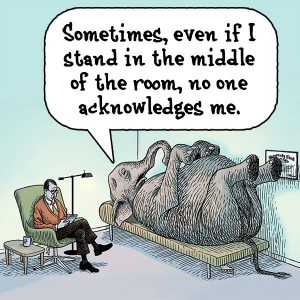
Whether it is movies or books: the tragedies walk away with glory; the comedies never get their due. Even look at authors…the comedy writers actually have a difficult task on their hands. Thinking of situations and dialogues which will bring out the juxtapositions and ironies of life and people, the element of surprise and suspense, the unexpected happenings : all of which give rise to a chuckle  or a smile from the reader or observer: a very difficult task indeed. But Literature and Drama recounts the tragedies as the greatest productions, which get remembered the most!!

Even in corporate lives we are forced to remain staid. No exuberance. Don’t show the joi de vivre. Business is serious stuff. Don’t smile too much….and never, but never laugh aloud. In the corridors of power and upper echelons of management, humor is looked down on as a dilution of the sanctimony of business. It seems like the lofty goals and objectives of the corporate world must be achieved with a serious demeanor. If you have a frown on your face and a “no nonsense” hard nose expression, you will be more respected and your efforts applauded more. Literally you should not giggle or laugh your way to the ‘Finish’ line: as you need to project the sheer dint of effort and seriousness of purpose to commemorate the achievement. Higher the success achieved more seriously must you project the struggle of reaching the goal. As if…if you laugh as you cross the end line, you are undermining the success itself!

Contrast this with the king of comedy Charlie Chaplin pronouncement: “A day without laughter is a day wasted”. On an individual plane, we all understand this truth. We want to be happy and smiling and laughing in our personal and familial lives. We enjoy company of those who make us laugh. We do not want to be around people who mope and crib all the time : they suck out even our energy. And yet we do not value those who make us laugh. We admire the “dark arts” but the proverbial Joker is considered lowest on the totem pole of society.

Are we afraid of the sarcasm side of humor? the loose comment which actually is an insidious cannon aimed at flattening the listener? We all know people who use humor as a defense, a wall to keep others out or to protect their own brittle egos. In such cases humor loses it’s innocence. It uses guile, an artful deception, duplicity to project friendliness but actually hurt and harm the other person. Truly it is not such humor which brings joy and smiles. Such a person is not actually funny. They are just being mean and trying to fool their audience by hiding behind their “joke”! Erma Bombeck noted correctly: ” there is a thin line that separates laughter and pain, comedy and tragedy, humor and hurt”.
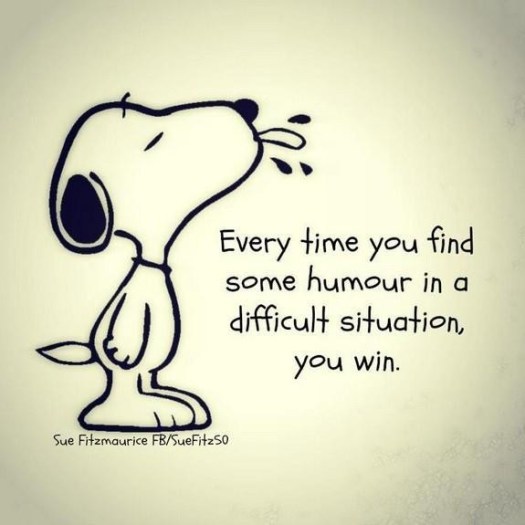
humor-in-a-difficult-situation

In another perspective, Will Rogers reminds us : “Everything is funny as long as it is happening to someone else”. Unfortunately, often we get so immersed and involved in the story and it’s developments, that we fail to retain a sense of objectivity. We invest  heavily in our own position; or in the opposition of someone else’s position that it becomes a “do or die” situation. Naturally we cannot see the humor in the situation. We have gone so close to the problem that it’s tentacles have enmeshed us: making us apart of the problem and depriving us of the “outsider” view which would have shown us the ridiculousness of our position and thus enabled us to escape it’s grasp and think of an easy solution. Taking oneself seriously is possibly the biggest dis-service you can do to yourself.

My 35+ years corporate experience convinced me that we do not laugh enough in the office space. Most laughter is contrived: like when the Boss or the Super Boss makes a joke and I have to laugh the loudest to provide evidence of my great sense of humor.And even as I laugh I am looking at the Boss to see if he is seeing that I am laughing at his pathetic asides!! Equality and camaraderie, which are sine qua non for humor to flower, are conspicuous by their absence in corporate boardrooms.

So where  does it hurt? In my opinion, humor has great potential and great power. It equalizes social and corporate power distances. It can be the oil and grease which  smoothens relationships.  It is a door opener: allowing easy entry into conversations and issues. When tempers are running high and positions are taken, humor can change equations and open closed minds. It brings much required levity to unnecessarily serious situations and people. It is a simple and readily available solution applicable in most distraught conditions and with the most difficult people. It has fantabulous stress busting capabilities. It is an sure charmer which endears you to the audience making you the soul of the party. In case any reader wants to understand more benefits of humor in social interactions I would welcome you to read anything by Oscar Wilde and/or PG Wodehouse and feel the calming effect and innate charm of humor in their own hearts.

Life has taught me to be a continuous learner. I never make the same mistake twice. I make it 5 or 6 times: just to be sure!!!

Hoping you learn to laugh at yourself:  joker vikas
writinghumour

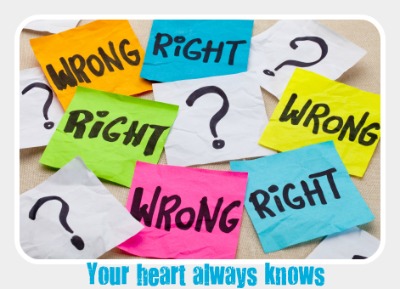
What is right…???

After all, what is right?

This question, seemingly simple, is a most complex one to unravel. And as we attempt to answer it: we are dragged further and further into the conundrum; from which many times there is no escape, no clear answer. At the most, we can compromise at some level, decide for ourselves : enough is enough –  and beat a hasty retreat. All the while convincing oneself that if we survive, we will live to fight another day: and find the “real answer; the absolute truth; what is actually right – on that other day!!!

Take the recent case of Sridevi’s death in Dubai. Morning shock  as she was loved by many cinegoers. First we hear that she died of a cardiac arrest. The press reports are full of surprise : she had no history of any cardiac problems! But  Doctors had opined …they have to be right? Soon comes the version of 29 surgeries in California; Botox injections galore; diet and hunger suppressants; medications to alter BMR;  so much torture to make the body beautiful, that the heart could not sustain and gave up. Within hours the reality changes: a new death certificate from Dubai does the rounds of social media where death is due to “drawing(sic!)” – all official; signed by the Physician in charge. And then :  drowning in bathtub is not the real culprit. Drink abuse. Husband should have stopped her. People suspect foul play.

Even when the body was brought back there was an eruption on the social media: after all she was just a performer; made money from acting; no known social commitments: does she deserve a State funeral? Are we demeaning the national flag which is wrapped around bodies of soldiers who die for the country? What is logic of wrapping this actor’s body in the tri-color? Again someone decided based on how they saw the situation. Some others object, as their interpretations vary. What is real? what is correct?

As observers,  relying on social media and reflected “reality”, we are confused. What happened actually? what is right? This is true of the Nirbhaya episode. Of the Ryan school killing. Ayushi Talwar’s murder. The infamous Tandoor Murder case with Youth Congress President Sushil Sharma’s involvement. Remember: No one killed Jessica? In a crowded restaurant, she is shot in front of hundreds: but prosecution eye witnesses turn hostile, one after the other. Manu Sharma is acquitted as the Sessions court concludes there is no evidence!! After public uproar, High Court hears the appeal and then Haryana Congress leader’s son is finally sentenced. But Manu Sharma still approaches Supreme Court as …no one killed Jessica!!!!

These are all high profile cases, but think about day to day issues also. Do we ever get a proper handle on “reality”? Do we get clarity on what actually transpired? We have all witnessed road accidents, and heard the multiple versions of who did what, when, how and finally what happened. Even when a smallest altercation takes place between 2 people: if you listen to their independent versions, you will end up with 2 totally contrasting perspectives. Think of the frequent arguments between spouses: does either ever feel I am wrong? ( We may say so just for buying peace temporarily,  but do we believe fundamentally that I was wrong?)  It is always ” But then you…”  “And then I ….” All sound and fury which never seems to converge! The differing views of the “reality” are so entrenched that it is impossible to judge who is right? what is real? and who has propriety on their side.

In business organizations today we actually encourage different points of view and call for groups/boards to discuss and decide the course of action. The underlying faith is that differing points of view and perspectives being brought to bear on an ambiguous situation will reduce the uncertainty of a futuristic decision. But the very process of discussing: does it not presuppose differing realities with each person;  and, a social reality we all must create jointly? Do we launch a new soap in an crowded market? Will this flavor of a new cream biscuit be accepted by the consumer? Will whole wheat noodles appeal as a more healthy alternative?  What is the strategy to win against competition? All complex realities with no clear cut right and wrong answers. And so we bring in cross functional teams, with their multi functional perspectives and try to understand what is the “real” way out? what will work? what should be the answer? what new reality do we want to pitch for and champion?  Finally the game is about defining what is THE right way ahead.

NoRightorWrong_Edited

Ask any Muslim Jehadi or a Tamil suicide bomber and they will aver what they are doing is right. Others may have a different perspective on this but then, that is “their” reality. When marketing spends are approved and a particular advertising is launched, there is faith is that it will work and generate customer pull for the brand. Reality , like market share or consumer voice, gets monitored and validated!!!

I believe the mistake we make is in searching for a single rule, a single tenet, a single principle: an absolute reality. As children we believed and behaved as though everything fell into right or wrong: black or white. As we mature we understand that all things don’t fit neatly into such boxes or labels. Most things in the world are not black. Most things in the world are not white.  Living and learning should teach us the new reality:  most things aren’t wrong or right. They are just different. Maturity is knowing that there is nothing wrong with different. We can let things be different, we don’t have to try and make them black or white, we can just let them be…..

My conclusion is best captured  by Joybell C author of The Sun is Snowing  (Sic! read the title again) “And when I was a child, I thought that God was the God who only saw black and white. Now that I am no longer a child, I can see, that God is the God who can see the black and the white and the grey, too, and He dances on the grey! Grey is okay.”

It is fine- Live your own right: vikas

School of experience

Let me begin with a confession :  I have learnt more from my mistakes than from my successes. And if I am considered a wise person today, it is because I have made many, many mistakes with gay abandon; nay, even pride!!!

I remember early in my career I transferred into the Siemens factory on Thane Belapur road: the veritable “holy grail” of rabid unionism of Dr Samant and RJ Mehtas of the 1980s. I took an operational decision which was wrong. Resultantly the entire Maintenance department stayed away from work. Being an engineering company, this was awkward: to say the least!! To complicate things, this happened on a weekend and was discovered only on Monday, by the top brass. I had tried to patch things up by burning some midnight oil over the weekend. But the union decided to teach this rookie personnel manager a lesson, and did not co-operate. Come Monday morning, I was summoned into the German Works’ Director cabin. But what he told me that day not only surprised me, but also gave me a life long learning!!

“Shirodkar, first wipe out that serious look on your face” he thundered. “what has happened? Is there a fire? Has anyone died? Has the factory totally shut down?” When I explained the productivity and mandays lost, his only counter was ” What did you learn from this incident? What will you do different next time?” Over the next 30+ years, I was to learn that taking a decision was more important than prevaricating and remaining indecisive. My mother’s kitchen’s teachings of not crying over spilt milk and being bold while experimenting with a new dish and presenting what you cooked with elan and flourish, have stayed with me since.

One major reason is exemplified by Johnny Cash, the best selling music artist of all times, who said “ There is no fence to sit on between heaven and hell. There is a deep wide gulf, a chasm” So make a call; learn your lesson and move on: falling down the chasm does not help. Take a stand. It is how you manage the implementation and aftermath of a decision that make it right or wrong for posterity.

As drivers we have all experienced this. When you are overtaking a vehicle, and there is oncoming traffic (so you must complete your maneuver quickly before the oncoming truck/car makes it difficult to overtake),  there comes a point when you are parallel to the speeding car ahead, and the moment of truth occurs: Do I press ahead and overtake? or better i reduce my speed and try again later? While it is good to be cautious and abort overtaking if the oncoming truck is too close, you cannot go on postponing the decision to overtake. At some point you must take the leap in your mind, increase speed further and overtake. Decisiveness and action;  over doubt and rethinking. No “fence to sit on”. Just make your move.

Like all Indians, am sure you too watch a lot of cricket. With the superior camera work today, one can actually sense the resolve of a Kohli or a Dhoni when they look at a ball and smash it for a sixer. In the same manner, the unforgiving camera catches the hesitation and the doubt, in the way the bat swings, when a ball is miscued and ends in a catch, or misses the line completely and the stumps rattle behind. The teaching is ingrained in the doing: which is why Dhoni has said in an interview ” I don’t study cricket. Whatever I have learnt is through cricket I’ve played on the field”. Experience itself is the teacher par excellence.

For meself, I must say although I am a good teacher, I am a much better student. I keep my eyes and ears open to new learnings that life affords me. And a la Papa Hemingway ” I like to listen. I have learnt a lot from listening carefully. Most people never listen”. Forget not that the Maker in his infinite experience has given us 2 ears and just 1 mouth. Listen double than what you speak. Enjoy all that is happening to you. Travel. Eat unfamiliar food. Meet new people. Open yourself to new experiences. You have to create and recreate yourself constantly.  My hoary 62 years have taught me : Just when I think I have learned the way to live, life changes. And thus, the learning continues ad infinitum!! So, Live each day as it comes. Be warned of Dorothy Dix’s caution, ” It is the dark menace of the future that makes cowards of us” 

For action, I take inspiration from the most famous follower of Martin Luther King viz. Rosa Parks. She spearheaded the Montgomery Bus Boycott to protest the Bus Segregation and went on to be called “the first lady of civil rights” by the US Congress.. When questioned about her courage in refusing to give up her seat to a white passenger she said ” I have learnt that when  one’s mind is made up, this diminishes fear; knowing what must be done, does away with fear”. What an prescription for facing up to life’s odds and experiences!!!

Life has a way of unfolding as it is meant to be. Remembering Papa Amrish Puri in DDLJ:   Ja Simran, jee le apni zindagi!

Trust Life. Experience fully: vikas


True or False

As children we all have enjoyed the game ” Truth OR Dare?”. What always intrigued me, in that game, was the underlying assumption that speaking the truth was something fraught with risk, full of tension and…to be avoided as far as possible!!!! Why has Truth acquired this persona? Am sure Goddess Veritas is not amused by the way we look at truth today!!

St Augustine had roared “Truth is like a lion. You don’t have to defend it. It will defend itself”.  But even here you will notice the imagery is negative…as though speaking the truth is a problem. Literally it begets the question: Can you handle the Truth? Myth has it that the goddess of Truth Veritas hid at the bottom of a sacred well as she was so elusive!!

truth image

All this is a far cry from the shining demeanor that Truth is clothed in romantically, and in literature. Common opinion projects that nothing can be purer than truth and truth can stand on it’s own, despite any opposition.  When Thomas asked Jesus’ We do not know where you are going? How can we know the way? Jesus replies ” Via et veritas et vita I am the way, and the truth, and the life : no one comes to the Father except through me”  (John 14:6). Truth is ascribed much power in the Good Book (John 8:32) : ” Then you will know the Truth and the Truth will set you free”.  Goethe affirms ” Wisdom is found only in Truth“.

Why then in today’s time has Truth  lost it’s shining glory? Is it because your truth and my truth may not be the same? In this age of duality and plurality have we lost the path? Has Truth suffered in the vedantic debates of Dvaitism and Advaitism? Buddha was clear when he affirmed that “3 things cannot be hidden: the sun, the moon, and the Truth” But if you just look around and follow the strident arguments taking place around you, you are tempted to ask the question: What is Truth? Who “owns” it? can anyone speak the truth; the whole truth and nothing but the truth? Why are there so many cases in the courts where both parties feel equally strongly that the Truth is on their side; and on their side alone? Did the lower courts not interpret and understand Truth in delivering their judgement? If they did: why are so many appeal Courts overturning the lower courts’ pronouncements: which in turn are challenged upto the Full Bench in a Supreme Court? and even there, there are dissenting judgments and opinions amongst the Full Bench!!! so who is right? who knows the truth?

truth

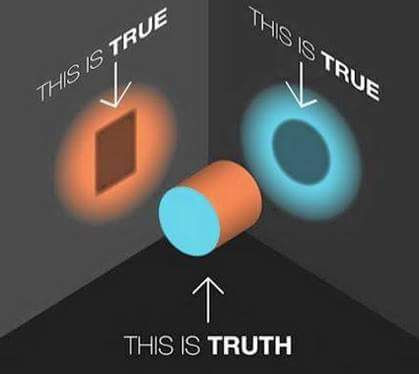
Says Swami Vivekananda, “Truth can be stated in a thousand different ways, yet each one can be true”.  Is this making life simpler or more difficult? I had read somewhere every great truth is a truth, whose exact opposite is also a truth!!!! So where does that leave simple folks like us who are trying to find a golden path through life’s complex questions? Oscar Wilde cautions “Truth is rarely pure and never simple”. Begging to differ from Saint John ( 8:32 quoted above) I would say that the Truth will set you free; but it will first piss you off!!!

For evidence I will parade all the arguments I have been a part of, where both parties, albeit speaking in stark contradiction, believed that Truth is on their side. On a wider scale, look at the Holy Wars, debates between Shias and Sunnis, Netaji Bose’s action agenda v/s Gandhi’s nonviolence; Jawaharlal Nehru and Mohammed Ali Jinnah, in modern times Israel and the Arab world, Netscape with it’s open source and Microsoft’s competitive dominance or the latest debates between Elon Musk and Mark Zuckerberg. Every area of human endeavor gives examples of opposite “armies”  righteously believing Truth is on their side. And in today’s daily Kurushetra, we miss an expert, a chatbot Krishna who can interpret and guide us on the way forward.

The dilemma of modern living is that were  Krishna to appear, his second act would be to disappear!! … and leave you to figure a way out of the conundrum, yourself! If you find the Buddha on the road, KILL HIM!!! We will do well to heed Alfred Whitefield’s advice ” There are no whole truths: All truths are half truths”. To which I will add my word of caution: & you may have got the WRONG HALF!!!!

truth image2

Don’t get me wrong. Like you, I am also brought up on the dictum: Truth is a truth even if no one believes it; a lie, is a lie, even if everyone believes it. Truth is like a surgery: yes it hurts; but it cures. Truth is visceral. It is there. Dogen said it so well “If you are unable to find the truth right where you are, where else do you expect to find it?” Better to be hurt with the truth rater than be comforted with a lie. My team members were always told to tell me the bad news first. No mollycoddling or sugar coating. Say it like it is. Tell me all and let me make sense of how badly we are mauled and how we will recover our position. Better to fight with eyes open knowing your sword is broken rather than getting surprises in action. Truth has a way of catching up with you. So like the Scout motto: Be prepared!!

I will end with a deep personal insight of the iconic Marilyn Monroe. She said” I am selfish, impatient and a little insecure. I make mistakes. I am out of control and, at times, hard to handle. But if you can’t handle me at my worst, then you sure as hell don’t deserve me at my best”. Instead of Marilyn, it might as well be Truth telling us this. Yes, Truth is hard to handle! Truth pushes you no end!! Beats you blue. And leaves you gasping!!! Yet I deserve the best. And, despite all the discomfort, I vote for Truth. Always.

Let Truth alone  prevail : vikas

truth4

Child as the Father

“Come with me, where dreams are born, and time is never planned” sang Peter Pan. I was taken on this magical journey with the casual visit of my niece with her 2 daughters.  And the photoblog of my dear friend Vivek ( http://www.vivekvsp.com) which begins with a bewitching photo of his granddaughter: a black-and-white invite into the color-filled world of children.

Annika

Children around us are indeed an enchanting return to a world where all is bright and beautiful, birdsong is perpetual, everything is possible and curiosity  & wonder know no end.

When I was a child, I wanted to grow older. But, this shit was not what I expected…. Disappointment galore!!!!  So now, all the time, one wonders whether regression is really bad? is there a return path? can we go back? Back to the excitement, the wondering and the staring? Indeed I realize my desire to grow up was misplaced as WH Davies sang long  ago:

What is this life if, full of care,
We have no time to stand and stare.
No time to stand beneath the boughs
And stare as long as sheep or cows.
…No time to see, in broad daylight,
Streams full of stars, like skies at night.
No time to turn at Beauty’s glance,
And watch her feet, how they can dance.

And  so “stop the world and let me off…I am tired of going round and round”. the only reprieve we “who have played the game and lost”  will now get, is the time we are privileged to spend with kids, around them,  playing with them,  seeing the world through their eyes full of curiosity and wonder. But everything is a ceremony and a celebration, in the Eden garden of childhood. Tom Stoppard captured it well, when he wrote: ” If you carry your childhood with you, you never become older”.

For the GenX who believe posting things on Tumblr and Instagram is more important than actually living the moment, a word of caution: most of our childhood is stored not in  photographs. Rather it lives in sights and smells. In the scent of biscuits and cupcakes that you so lovingly imbibed : even as you crossed the friendly neighborhood bakery, on the way back from school!! Childhood lies in the smell of your mother’s saree which filled your nostrils when you rushed to hug her when you returned home; the smell which still lingers and reminds you of the safest place in the universe!!! Childhood is entrapped in the early morning light when you woke up and crept into the living room to have a cuppa with your parents : pretending you liked without sugar tea as you wanted to show how grown up you were, just like your parents who had tea without sugar !!  Childhood lies in the thick curtains you experienced on your first holiday at a posh hotel; in the lovely sunsets you saw with family at the hill station; and even in the smell of petrol and engine oil when the car broke down in wilderness and your father gamely tried his hand at repairing the car, to take his precious family to a safer haven before nightfall. Indeed childhood, and the associated memories,  make you richer than Plutus and happier than Happiness itself.

children

Paulo Coelho avers : ” A child can teach an adult 3 things: to be happy for no reason, to always be curious and to fight tirelessly for something”. Were we to assimilate these 3 values and live by them, I am sure not only would we be happier but also  make the world a better place for all whom we come in contact with.  From my grandchildren I have learnt the importance of living fully and living well, of sharing and caring without fear or favor, the joy of giving and taking pleasure in another’s joy and success.

gargut

Imagine a corporate world where we lived by these principles:  which the children in our lives can so easily teach and demonstrate to us. Imagine being happy and satisfied with our lot and not feeling jealous of what others have or receive. Imagine standing up and  taking responsibility, volunteering for work assignments as they give us joy of expression and proving our capabilities. Imagine doing things without being afraid of being laughed at or singled out for ridicule. Imagine stretching ourselves continuously because we enjoy contributing with all our might. Imagine the whole organization applauding whenever there is an achievement which adds value to the company.  Imagine doing what is right and doing it with full confidence. Imagine “Sharing Caring and Joy” define organizational culture. Where Win-Win thinking is practiced by all with full gusto. Can we imagine and help create such a corporation?

Our inspiration will come from children. They live freely and positively all their lives. Now we who have “grown up” ( or should I say “grown down” and “grown in” ) have simply to learn and practice a new religion: Be the one you needed when you were younger. The inspiration and the way forward lies with the young. Can we became children all over again? in spirit and demeanor,  if not in in age? Can we attack every challenge with a “never say die” spirit? Can we be all conquering? Can we keep smiling when we win;  and more importantly, when others win? Can we leave behind our narrow sense of self and be all encompassing through joys and tribulations, through failures and challenges? In sum, (as Hugh Prather, Notes to Myself says )  “can we just be, instead of being for” ?

I end with Poet laureate Wordsworth’s words

My heart leaps up when I behold
A rainbow in the sky:
So was it when my life began;
So is it now I am a man;
So be it when I shall grow old,
Or let me die!
The Child is the father of the Man;
And I could wish my days to be
Bound each to each by natural piety.

thumb_IMG_7679_1024

Gargee, my grandchild, teach me your innocence and love: vikas

Give or Take?

All of us have met both types of people in our lives. Some are givers, some are takers. What is better? To Give? or to Take? Come, let us explore this.

Early in life I realized that giving is noble. It make you feel better. Your hands are on top. You are the benefactor. You feel proud. And then came along a story of a Zen Buddhist master who was gathering contributions to erect a new Monastery. The Master would go around with a sack slung over his shoulder and whatever he recd, he happily put in the sack and moved forward, to ask further. On his travels, he reached an Emperor’s palace and made his request. Convinced of the cause, the Emperor ordered 100 Gold Coins be given to the Master for the new Monastery. When the coins were proferred, the Master put them in his sack; slung it on his shoulder and started moving out of the Palace. The Emperor accosted him “Master, even for a King, 100 Gold coins is a lot. I have given such a large gift. Will you not say anything? Are you not grateful?” Pat came the Zen Master’s reply ” It is Giver who should be grateful” and he walked on…

Like all Zen stories, this gives a strong message subtly: indeed the Giver should be grateful: he should understand that his better position, that enables him to give. Do we understand this? or do we want the receiver to kow-tow before us and feed our ego? Yet when we expect gratitude/thanks/”receipt” for our giving: are we not cheapening our gift? Are we not making it totally transactional? Putting a value/price to our act?

And yet, that is how most of us are. As soon as we receive a bequest, we are already calculating how can I return the favor? We have already put a value to our gift, and are wondering what must I do in return? In my opinion, by this very thinking we bring down the Giver and his Gift to a lower, pedestrian level The nobler thought of gratitude is exchanged for the banal “how do I return this?” thought: making the whole thing  transactional, a daily matter of give and take.

On the other hand, if we remain grateful and feel obligated, we elevate the Giver to a nobler level.We recognize his pre-eminence and acknowledge his superiority. We make him richer and more important. Thereby priming the pump for him to do more good, help others, give more… acting on the principle of “Feed Forward” whereby more good radiates all across: you “return” the favor you received by doing good for others in your life, rather than “closing the account” with one person. Your becoming a Giver radiates the feed forward idea and overall there is more positive valence and joy in the relationships you touch.

We were in Atul, where hundreds of families showered love and affection on us. Still do. Could we “return” all that we got, to the people who gave? No. But we could carry the positivity forward, in ensuring we give to others more, if not in equal measure, to all that we receive. We just returned from a vacation abroad where families we had not met for years played perfect hosts and made our stay in a foreign country totally enjoyable and fun. Can we return their “good”? Yes, by being good to others. This is what gets the world to go around.

I recently came across a story of a teacher and his pupil who were walking in the woods. They found abandoned clothes in the wilderness, obviously left there by the farmer who was working the fields. The child said to his teacher: ” Shall we hide the clothes and then see the discomfiture of the farmer when he returns?” The teacher made a counter suggestion “Shall we instead put some coins in the pockets and hide and see the farmer’s reaction when he returns?”. They played out the teachers suggestion and put some coins and hid to see the farmer’s reaction. When the farmer came back, and while wearing his clothes, discovered the coins, he broke down and said  “God I thank whoever did this kind deed. This will enable me to buy some extra bread to feed my sick wife and hungry children.” The pupil had learnt his lesson : how it is far better to give than to take away.

Recollect the times when you were going through a difficult time in your career and others came forward to lend a hand? You were hard pressed for time to complete an activity with a strict time line, and a colleague offered to share the load with you? You were unsure which road to take and miraculously people appeared who guided you on the right path? Solutions often come forth from unforeseen quarters and people because when you are positive in your approach,  you do attract positivity around you.

An award winning corn farmer understood that he must share his prize-winning corn seeds with  neighboring farmers: since winds that blow, carry corn seeds  across farms. So if my neighbors’ fields have poor quality corn: those seeds will get mixed with mine and reduce the quality of my output. If my farm must produce good quality corn: then my neighbors’ farms must also have good quality corn. The positive I do will come back to me: that is the principle of the feed forward. To get I must give.

To end, let me quote another favorite Zen story :  a man was unhappy as his wife was very tight-fisted, never helped others and never shared openly within the family & friends. The man invited an enlightened Zen Master to guide and educate his wife. The Master came and saw the wife was unhappy with even the additional mouth to feed but did not say anything. He observed her stinginess and narrow mindedness and still said nothing. All slept, and  next morning, before he was to leave, he called the wife and showed her an open palm with his fingers stretched out. He asked the wife: “If my hand always remained like this and I could close it, what would you say?”  “It is deformed and bad” was the wife’s reply. “Yes” said the Master; & ” if my hand was closed tightly in a fist and always remained like this and I could not open my palm: what would you say?”    ” It is deformed and bad” was the wife’s reply. “Great” said the Master ” if you understand this I have nothing more to say to you.” The Master left. The wife learnt her lesson, mended her ways.

Hope we all understand this lesson and learn to give so that we get:  vikas

My Choice

John Steinbeck, in his typical profound manner, tells us: ” the Hebrew word timshel—‘Thou mayest’— that gives a choice. It might be the most important word in the world. That says the way is open. That throws it right back on a man. For if ‘Thou mayest’—it is also true that ‘Thou mayest not’.” (emphasis added). How well this captures the entire journey of our life!! It is always a struggle between “thou mayest” and “thou mayest not” and the final choice that we make in a given circumstance. Truly the choices that we make, make us!!!

Imagine that fateful day, when young Narendra decided that he must meet someone who has “met God” and was in search of such a Guru. On reaching Dakshineshwar he asked  “Have you seen or experienced God?”. The fateful reply of Ramakrishna,”Yes, I have seen God. I see Him as I see you here, only more clearly. God can be seen. … If one cries sincerely for God, one can surely see Him.”. Bewildered and puzzled, Narendra returned to Calcutta, but  was convinced the words sprung from deep inner experiences. So he returned to meet Ramakrishna again and again; till he was transformed into Swami Vivekanada. Advaita Vedantism owes a great debt to that fateful meeting and of course to Vivekananda’s decision to go to the Parliament of World’s Religions at Chicago in 1893. His speech there ” Sisters and Brothers of America, It fills my heart with joy unspeakable to rise…” changed the course of seeing Hinduism as the religion of true tolerance and universal acceptance.

Or take the case of Gandhi. When travelling to Pretoria, with a legitimate First Class ticket, he was thrown off the train on the instigation of a white man. Instead of fleeing the scene, Gandhi stayed back for 21 years to fight for Indians in Africa. Gandhi’s travails at Pietermaritzburg railway station was akin to a second birth.  It was said: “When Gandhi was evicted from the train, an Indian visiting South Africa fell but when Gandhi rose, an Indian South African rose.” The aborted train journey finally took Gandhi far beyond Pretoria!! His concepts of peaceful resistance were born from his choice of not accepting injustice. This in turn would shape his entire Nonviolence and Satyagraha philosophy which gave India its freedom from the British; while till then “Sun never set on the British Empire” The first blow to that superstructure was in Peitermaritzburg;  finding its resonance in the birth of India, Pakistan, Australia,  Kenya,  and so many other countries’ independence. (Sotto voce: we must locate and thank the white man who objected to Gandhi’s presence in the train compartment!!) General Smuts put it well:”men like Mahatma Gandhi redeem us from a sense of commonplace and futility and are an inspiration to us not to weary in well doing”. Truly, to do or not to do:  it is our choice!!!

Jawaharlal Nehru’s approach on Article 370 and  J&K; his actions and decisions in the China War in 1962 were bereft of his genial Chacha Nehru lover of children and roses image.  His choices at that time shape our present day actions vis-a-vis J&K as well as China.

Indira Gandhi’s Declaration of Emergency in 1975 gives many great examples of choices altering the course of history. The split of the hoary Congress that Indira engineered in 1969 – Congress(O) and Congress(R) – were the beginning of her megalomania. Riding on the back of populist measures like Nationalisation of Banks & Abolition of Privy Purses, Indira got a catchy slogan of Garibi Hatao to pilot a thumping majority in Parliament in 1971 elections. This fueled her greed for power even more. Newly anointed with Bharat Ratna, Indira won a war against Pakistan, freeing Bangla Desh. She started dominating the judiciary after the Kesavanada Bharti case and cases against the 24th Amendment not going her preferred way. Challenges began with Nav Nirman movement in Gujarat and agitation of Bihar Chhatra Sangharsh Samiti under the leadership of Jaiprakash Narayan(JP).  Ignoring the assassination of Railway Minister LN Mishra or the ruthless suppression of the Railway Strike by Indira only showed her decisions/choices progressively becoming undemocratic and totalitarian. The final straw was the Allahabad High Court decision finding her guilty of misusing governmental machinery in her campaigning, declaring her election null and void, unseating her from the Lok Sabha. When the Supreme Court also upheld the HC decision, strikes swept the country in trade, students and government unions. Indira’s choice and decision was to get a compliant President sign on a Proclamation of Emergency.

Even a simple recounting of these events shows the number of fork points and decisions ingrained in the choices made by all actors in this drama. We can  conjecture many, many “what-if” scenarios. There will be no definitive answers to questions like what-if Raj Narain had not challenged her election; what-if the HC judge had not ruled against Indira; what-if SC had overturned the HC decision; what-if JP and Nav Nirman movements had remained dormant; what-if SS Ray had refused to prepare the note recommending declaring  Emergency; what-if Sanjay Gandhi had not implemented forcible sterilizations… Questions, questions, questions. But you get the point I am driving at. Our lives are shaped by choices: choices that we make and choices that others around us make.

On a purely personal plane: I was always enamored with English Literature. Wanted to study and then teach English as a career. When I chose Humanities everyone advised me my life would be ruined. I would live to regret the wrong choice I was making.  Then came a time when there was a choice to shift to studying Psychology and specializing in Organizational Psychology. After that my career aspiration became teaching Psychology. Soon life presented another choice: IIM Calcutta. Having cleared entrance exams with difficulty,  I chose to study Personnel Management & Industrial Relations(PMIR) in IIMC!! Again I faced ridicule and disbelief since my choice was not Systems or Marketing or Finance in the proverbial melting pot of IIMC. I chose PMIR as it would add value to my psycho background. Today my choices have made me: a service oriented professional, happy building other’s careers and coaching them to succeed. I am what my choices have made me.

My final take is destiny is not predetermined; it is a matter of choices we make. Think of Vivekanada restlessly asking to see God. Think of Gandhi emerging stronger from his fall in Peitermaritzburg. We shape and create our life, and our future, through our choices. Indira’s death was also shaped by her choices. Richard Bach put it beautifully: “we are free to choose a different future: or even a different past”.  Think about that.

Let me end with the philosopher of philosophers Aristotle: “Excellence is never an accident… it represents the wise choice of many alternatives – choice, not chance, determines your destiny.”

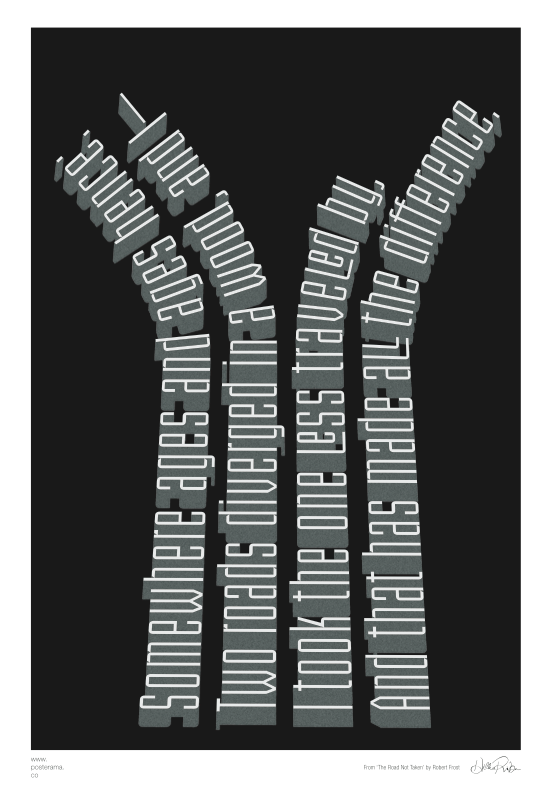
Robert Frost sang beautifully: Two roads diverged in a yellow wood,
And sorry I could not travel both
… long I stood;  And looked down one as far as I could
To where it bent in the undergrowth…

So friends make your choices wisely: and walk the road less travelled: vikas